
The first edition of the Kadohadacho News for 2015 is out! Check it out for information on fieldwork at Dooley’s Ferry, Caney Cemetery, and the Samuels-Turner House, as well as an announcement of our upcoming speaker!
Manuscript Monday: Jeter et al’s Overview of the LMV
Today’s Manuscript Monday is an important overview of Arkansas (and Louisiana) archaeology. Well, the southern portion of Arkansas, at least. Jeter et al’s (1989) Archeology and Bioarcheology of the Lower Mississippi Valley and Trans-Mississippi South in Arkansas and Louisiana. I’ve been using this a lot in working on the final report of last February’s fieldwork at Wallace’s Ferry, in Phillips County. Though that site is in eastern Arkansas, this book is relevant to this neck of the woods as well, and bears the marks of Frank Schambach’s heavy contributions to the work. It is one of the most recent summaries of the region’s prehistory.
Copies are available at Magale Library at SAU as well as the Barton Library in El Dorado.
Let’s Give Manuscript Mondays a Whirl
We’ve been trying a number of weekly social media events on the Facebook pages of various Arkansas Archeological Survey (ARAS) stations. “Throwback Thursday,” a wide-ranging phenomenon across the Book of Faces, has been used for showing off images from past fieldwork. In the past year or so, some of our stations have been contributing to “What Did We Find Wednesdays,” showing interesting or evocative finds.
These two basically show data collection (fieldwork) and analysis (artifacts). But, what of the final stage of archaeological research, reporting results? Let’s address that with a new section, which to continue the trend of alliterative titles, which I’m dubbing “Monograph Mondays.”
Some guiding principles
- The work can be a book, journal article, or piece of gray literature, but it should be quality work and an important contribution to our understanding of the past in your respective research areas. These can be, but don’t have to be, the “master works” for local areas. If it’s interesting, write a blurb about it.
- The material should be available to the general public in some way shape or form. If it’s a book, it should at least be available in the library of your station’s host institution. If it’s gray literature, it should be available from a source such as DTIC (for Department of Defense reports).
- Preference should be given to works that you don’t need three PhDs and a spare brain to understand.
- While giving some idea of what the work is about, you don’t need to give a full report on it. A little taste will suffice
Now it’s up the flagpole. Let’s see if anyone decides to salute.
June Rambles for the ARAS-SAU Crew
June is a busy month for the Arkansas Archeological Survey. Each year, we help run the Arkansas Archeological Society’s annual Training Program dig, a 2.5 week-long excavation on some important site, somewhere in the state. The Society Dig, as we call it, rotates around the state, and was last in our neck of the woods in 2011-2012, when we dug at Block Six, in Historic Washington State Park (Hempstead County). This year, it was at site 3MN298, a Caddo/pre-Caddo site up in Montgomery County, near Mt. Ida. Both Dr. Brandon and Dr. Drexler were in attendance, helping Dr. Mary Beth Trubitt (ARAS-HSU Station Archeologist) and Mr. Meeks Etchieson (U.S. Forest Service) with the digs. Several Kadohadacho Chapter members, including Bob Campbell, Kelly Schnell, and Don Hall, were in attendance.
Dr. Brandon taught the class on ceramics, playing to a room full of very experienced Society members, which kept him on his toes. This is the seventh different class that Dr. Brandon has taught at a Society Dig, suggesting that he is banned by the cosmos from ever repeating a course. In another ten years, we may have him teaching archaeoastronomy, just to ensure that his streak continues. While not teaching ceramics, Dr. Brandon was out at Area V, assisting Vanessa Hanvey (ARAS-HSU Station Assistant) with excavations there.
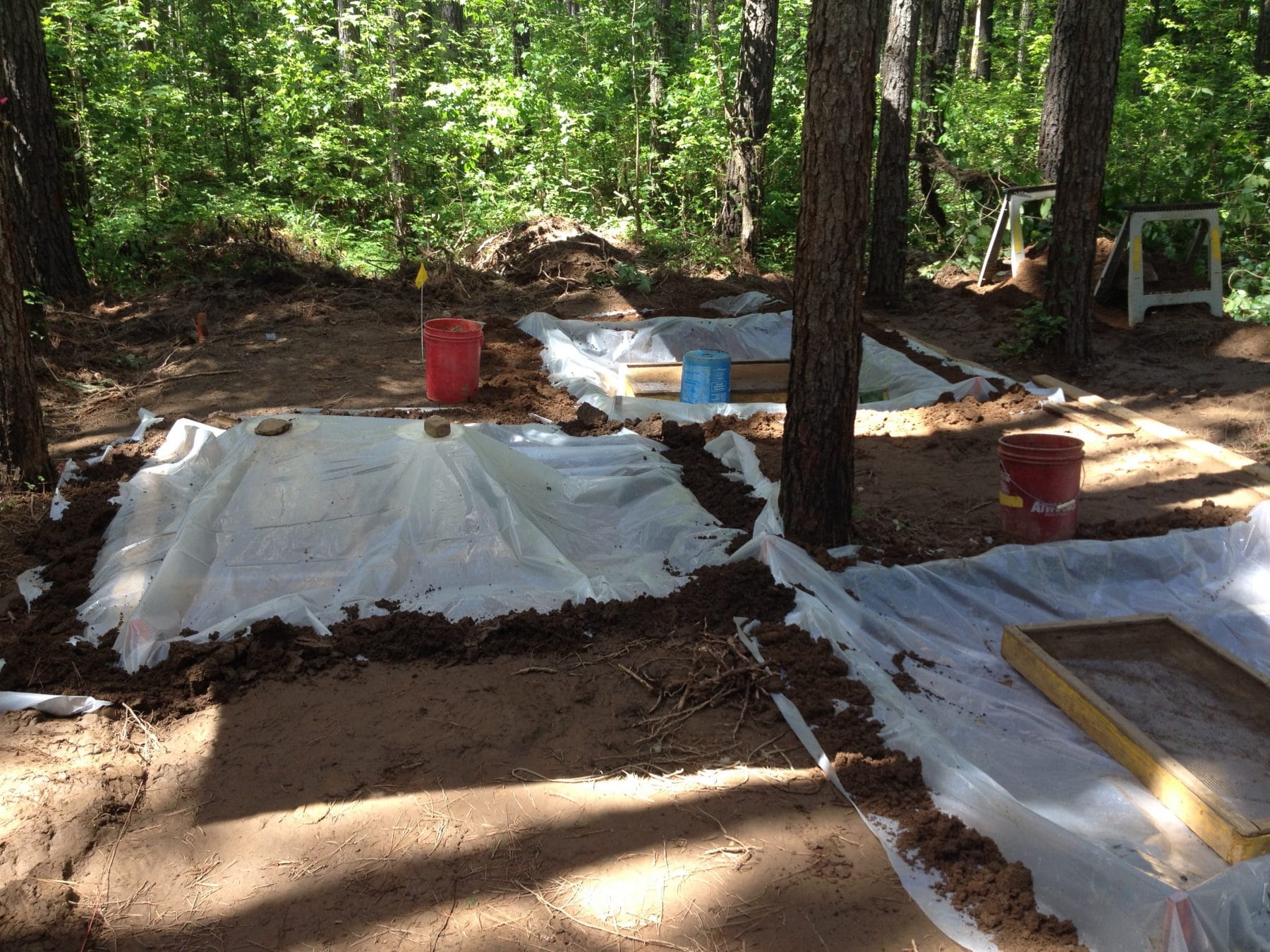
Basic Excavation Units, Covered Against Rain
During the first week of the dig, Dr. Drexler taught the Basic Excavation course, working on three 2x2m units (see photo) with 12-13 students, most of whom were eager, enthusiastic college students or recent graduates. Dr. Don Bragg helped out as an unofficial teaching assistant, and proved to be invaluable. Though the Basic Ex units were supposed to be relatively quiet (one doesn’t want to jump into a really complex area when just learning how to dig), each of the units encountered some interesting feature… or features (they averaged over five features per unit by the end). These included a possible hearth, a maze of post holes, and a large storage pit. We even found excavation pits and auger holes from the first fieldwork at the site, back in the 1980s, allowing us to tie this archaeological research in with preceding efforts. Given that we were under instructions to recover all feature fill as flotation samples, we trucked dozens of bags of soil out of the site every day, which boggled the mind of Dr. Jeff Mitchem (ARAS-Parkin), who served as lab director, and gave Dr. Elizabeth Horton (ARAS-Toltec) more than enough to keep her flotation tanks running each day.
Since getting back, Dr. Brandon has continued his preparations to move to Fayetteville and take up his new position as UAF Station Archaeologist. Today is, actually, his last official day as SAU Station Archaeologist, and we wish him all the best in his new opportunity.
Dr. Drexler spent the bulk of the week following the dig assisting Dr. Horton at Toltec Mounds State Park. We laid out a grid over a proposed septic tank litchfield in preparation for Dr. Jami Lockhart’s (ARAS-CSP) upcoming survey of the area. We also established the basic footprint of Dr. Horton’s new garden, which will show park visitors the kind of things that the occupants of Toltec would have been cultivating. Keep an eye on this effort over the coming years!